The question this study was built to answer
Can content written for one specific buyer — one persona in one situation — change what AI models recommend to that buyer, and only that buyer? If it can, AI visibility is something a brand can aim. If it cannot, it is weather.
We ran the test on a live programme in a contested category: Singapore Management University’s Master of Applied Finance, against the four programmes applicants actually weigh it against.
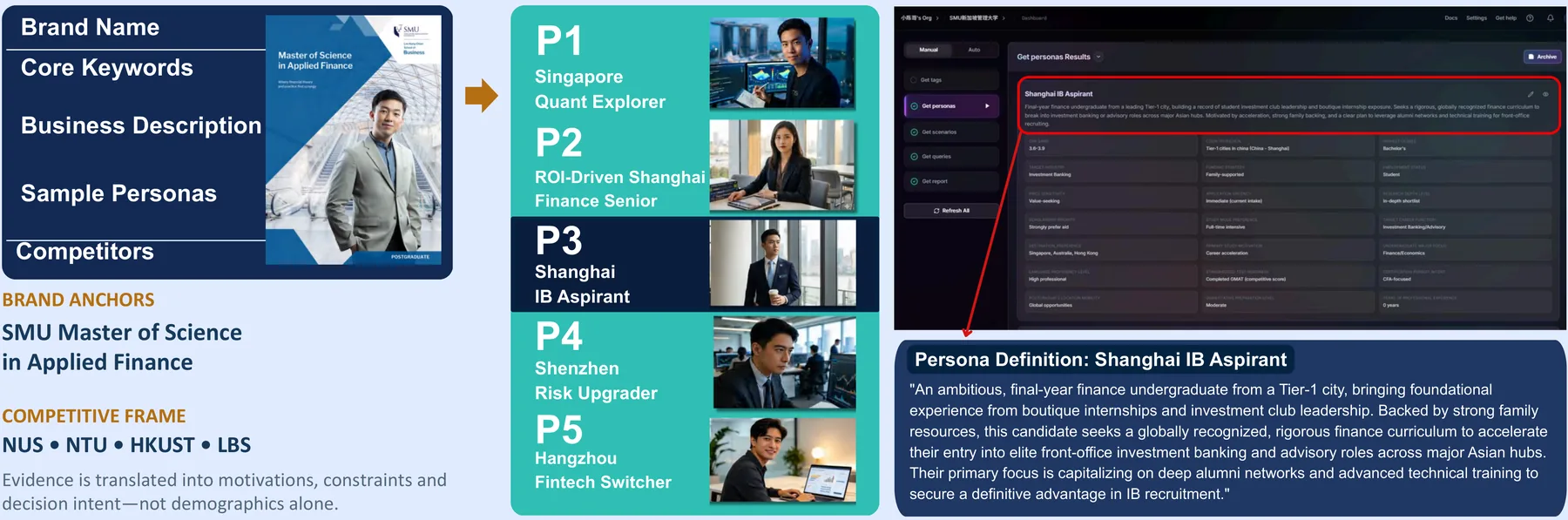
Step 1: five personas from SMU’s own material
Brand name, core keywords, programme description and competitors went into JefurryAxis, which decomposed them into tags and clustered five applicant personas. Not demographic bands — decision profiles, each with a motive, a constraint and a timeline.
Step 2: persona × situation → brand-free questions
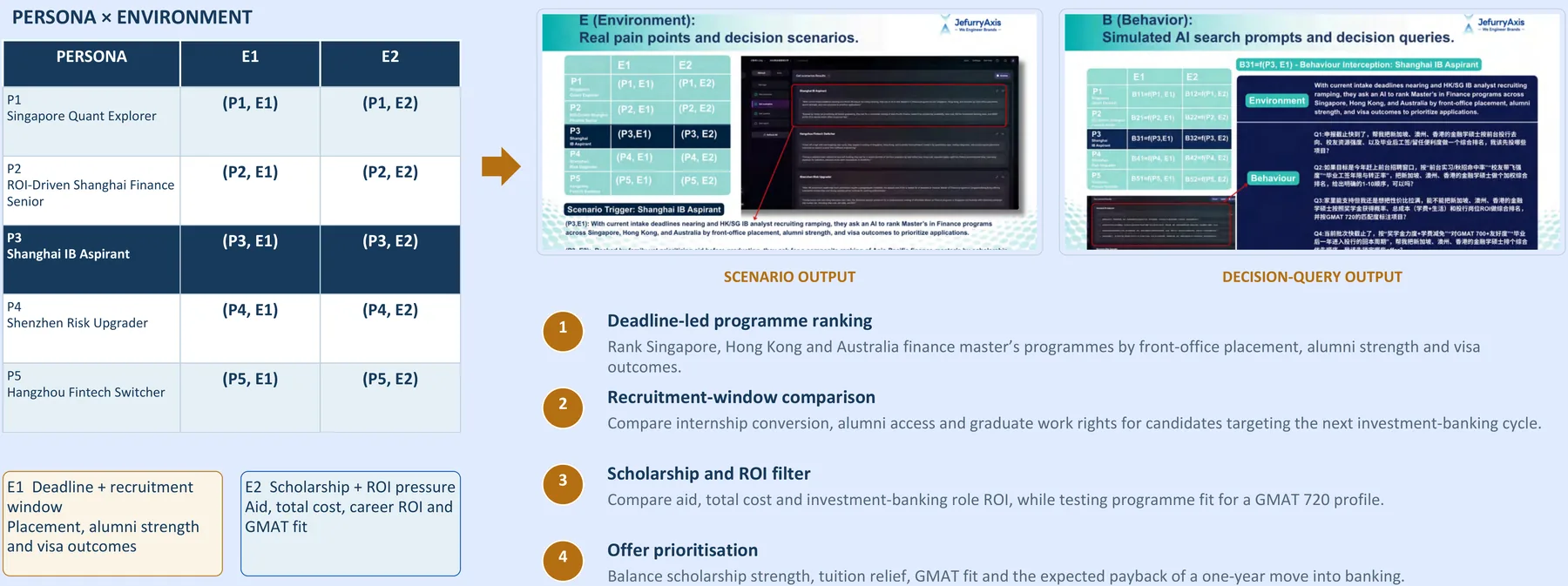
Each persona was crossed with two situations — E1, deadlines closing with the recruiting window next; E2, scholarship and return-on-investment pressure. Behaviour follows from both: B = f(P, E). From the target cell, B31 = f(P3, E1), came questions like these, none of which names SMU:
- “Deadlines are close. Rank the finance master’s programmes in Singapore, Australia and Hong Kong by front-office banking placement, alumni strength and post-study work rights — which should I apply to first?”
- “Compare internship conversion, alumni access and graduate work rights for someone targeting the next investment-banking cycle.”
- “Rank them by scholarship odds, total cost and investment-banking ROI, and flag the fit for a GMAT 720 profile.”
Step 3: the baseline, 28 January 2026
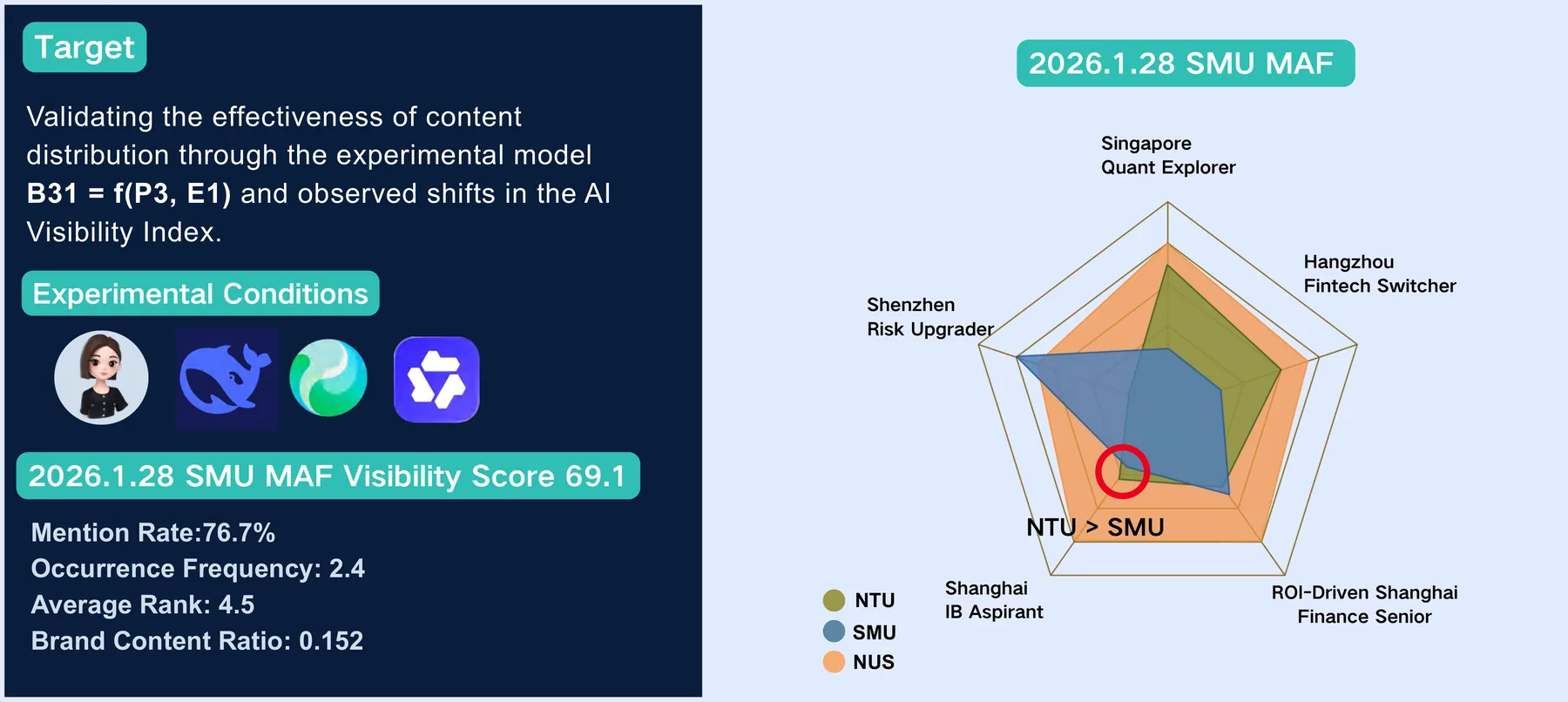
Each question went separately to Doubao, DeepSeek, Qwen and Yuanbao, and each was asked more than once — a model does not answer the same question the same way twice, so one screenshot is not a measurement. The baseline Visibility Score was 69.1:
- Mention rate 76.7% — named in about three answers in four.
- Occurrence frequency 2.4 — named, rarely discussed.
- Average rank 4.5 — mid-list.
- Brand content ratio 0.152 — about 15% of each answer.
On the target persona, NTU was ahead of SMU.
Step 4: ten articles, written for one person
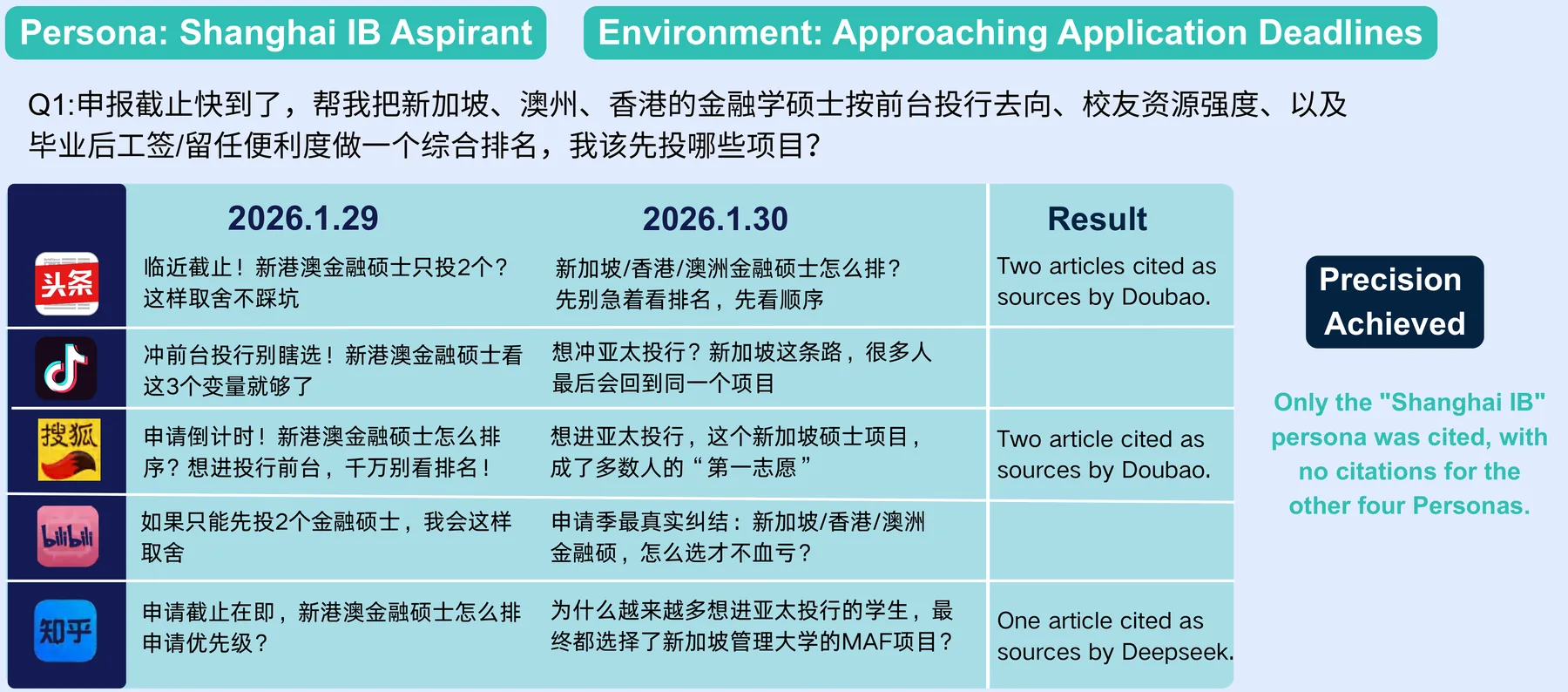
We did not touch SMU’s website. The baseline run showed which third-party platforms these models actually cite, so that is where the content went: Toutiao, Douyin, Sohu, Bilibili and Zhihu, one article on each on 29 January and another on 30 January. Every piece answered the target persona’s decision in that situation — which programmes to prioritise, how to choose if you can only apply to two, what actually decides a front-office outcome — using programme facts that could be sourced.
What changed
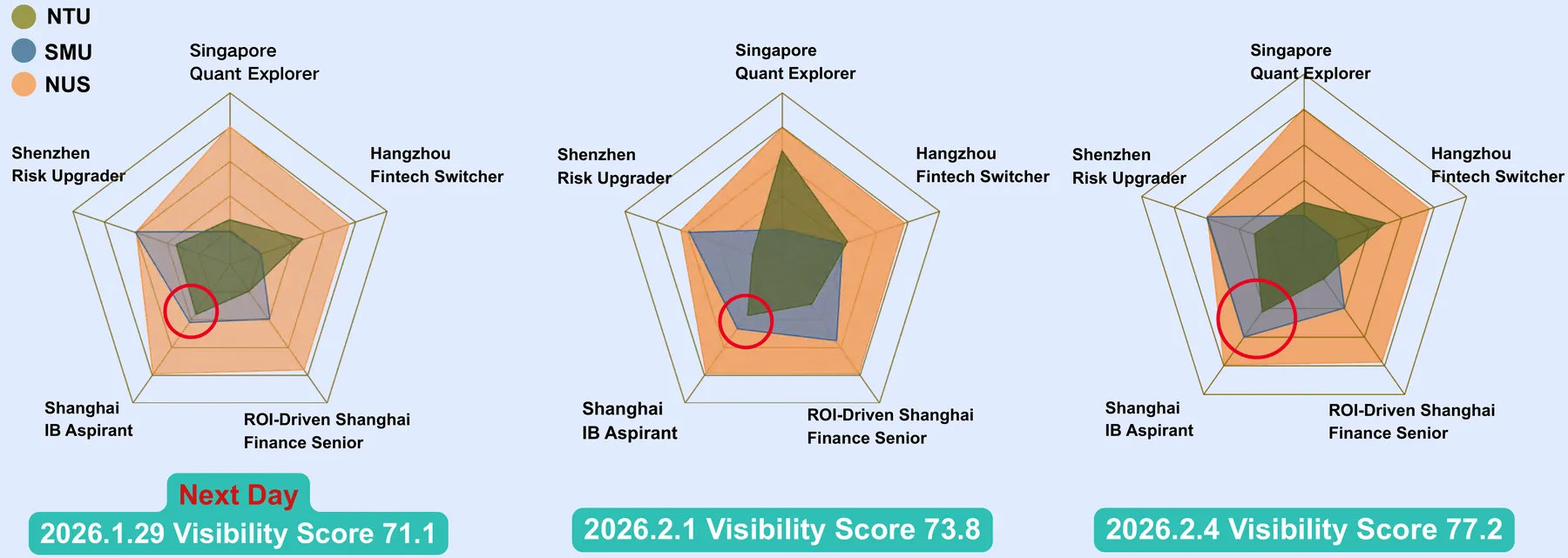
| Date | Visibility Score | What happened |
|---|---|---|
| 28 Jan | 69.1 | Baseline. NTU ahead of SMU on the target persona. |
| 29 Jan | 71.1 | First five articles live. SMU moves ahead of NTU on the target persona the next day. |
| 1 Feb | 73.8 | All ten live. Five of them cited as sources in sampled answers: four by Doubao, one by DeepSeek. |
| 4 Feb | 77.2 | SMU still ahead of NTU on the target persona. |
Same questions, same models, same scoring on every date. The only variable introduced was content, placed where the baseline showed the models read.
The finding that matters most: precision
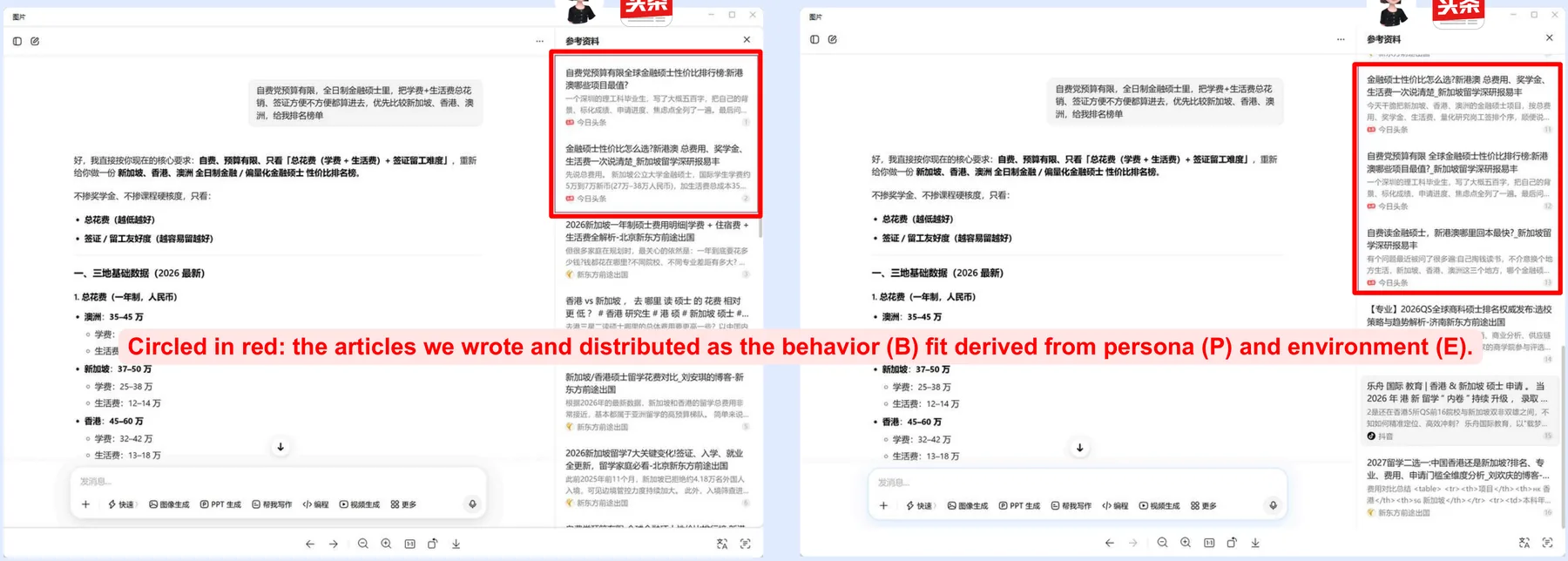
Our articles were cited as sources only under the Shanghai IB Aspirant’s questions. Under the other four personas’ questions, none of them was cited.
That is the point of the study. If the content had been cited everywhere, the honest conclusion would be that we had made SMU generally more findable — useful, but not proof of anything. Instead, the models used it for the person it was written for and nobody else. The targeting held, which is what the persona-driven model predicts. It also means the other four personas are separate work: there is no spillover to wait for.
The research behind it
Peer-reviewed · ANZMAC 2026
“Persona-Driven AI Engine Optimization in Zero-Click Search” — Dr. Yun Jia (listed by the conference as Jia YUN), Jeffery Asia. Accepted for an oral presentation at the Australian and New Zealand Marketing Academy Conference (ANZMAC 2026), Massey University, Auckland, 30 November – 2 December 2026, following peer review.
The paper sets out the framework this case tests. Content has to pass three gates before an AI names a brand: it must match the situation to be retrieved, the persona to be selected for the right person, and carry brand-specific evidence to be recommended rather than merely listed. The SMU MAF study is the paper’s case.
See the ANZMAC acceptance letter · ANZMAC 2026 ↗ · Case on jeffery.asia ↗
Limits of what this shows
- Visibility, not enrolment. This measures what four AI models said in response to a fixed question set. Applications, enquiries and enrolments are tracked in the university’s own systems.
- Seven days. Long enough to see a clean effect; too short to call a trend. Citations decay when content is not maintained.
- Chinese models only. ChatGPT, Claude and Gemini read different sources and need their own run.
- Answers vary. The same model words the same answer differently each time. Repeated sampling keeps that variation inside a known margin; it does not remove it.
Questions about this case
Was SMU’s website changed during the study?
No. All ten articles were published on third-party Chinese content platforms — Toutiao, Douyin, Sohu, Bilibili and Zhihu. The website was left as it was, so it could not explain the change.
Which AI models cited the articles?
Five of the ten articles were cited as sources: Doubao cited four (two on Toutiao, two on Sohu) and DeepSeek cited one (on Zhihu). Visibility was measured across Doubao, DeepSeek, Qwen and Yuanbao.
Did the other personas benefit?
Our articles were not cited under any of the other four personas’ questions. Each persona needs content written for it.
Has this method been peer reviewed?
Yes. The study is written up as “Persona-Driven AI Engine Optimization in Zero-Click Search”, accepted for an oral presentation at ANZMAC 2026 after peer review.
Want the same measurement for your brand? The first step is a baseline: your personas, their questions, and where AI places you today.
How a run is built and scored · The RedNote case: a closed platform, from absent to cited