Why this case exists
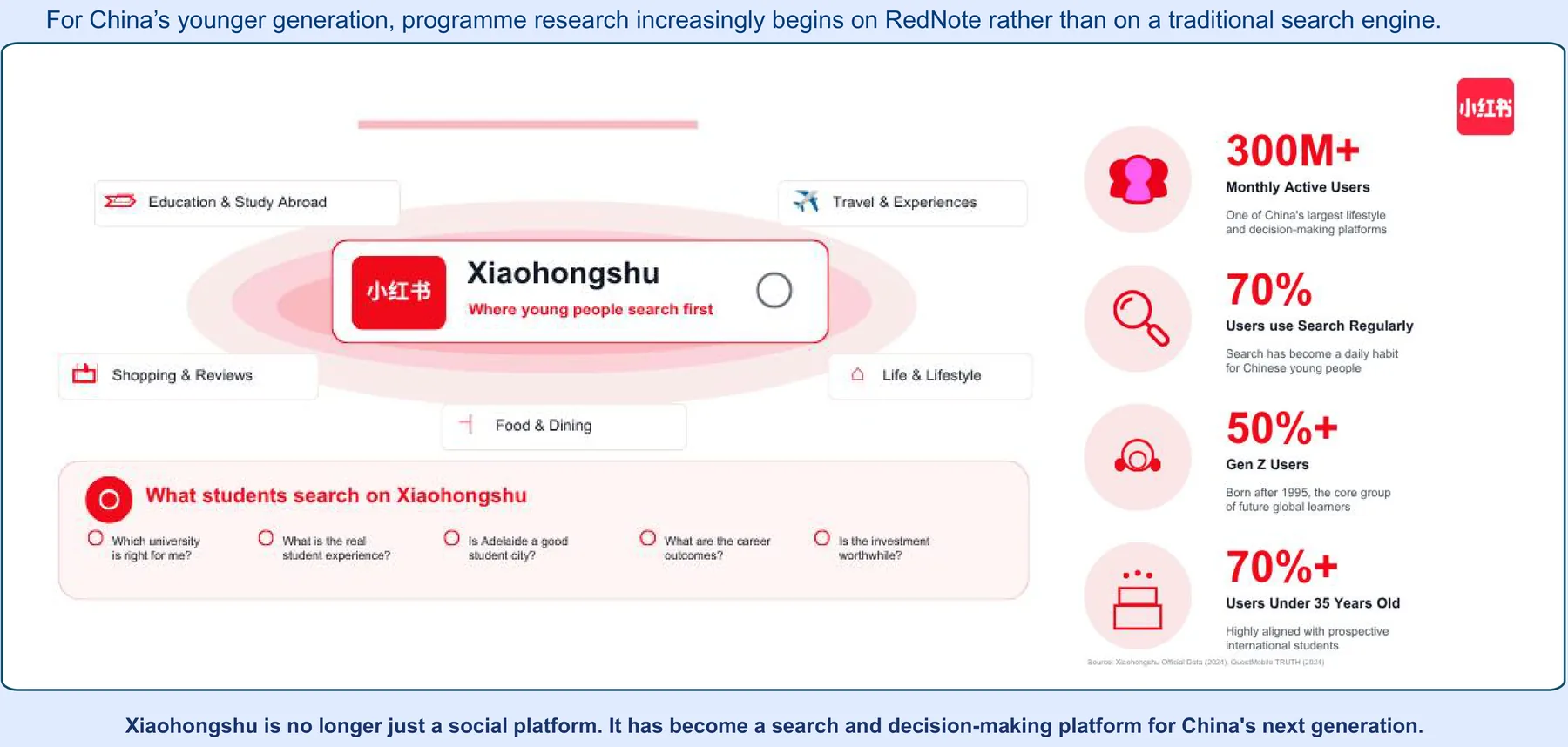
Most AI-visibility advice assumes that good content, published anywhere, can be found. On closed platforms that is false. RedNote Ask builds its answers from posts and comments inside RedNote. A brand’s website, press coverage and structured data do not rank lower there — they are not in the corpus at all.
And the platform is where the decision often starts. RedNote reports more than 300 million monthly active users, most of them under 35, and 70% of them search it regularly.
The method: select, design, deliver, report
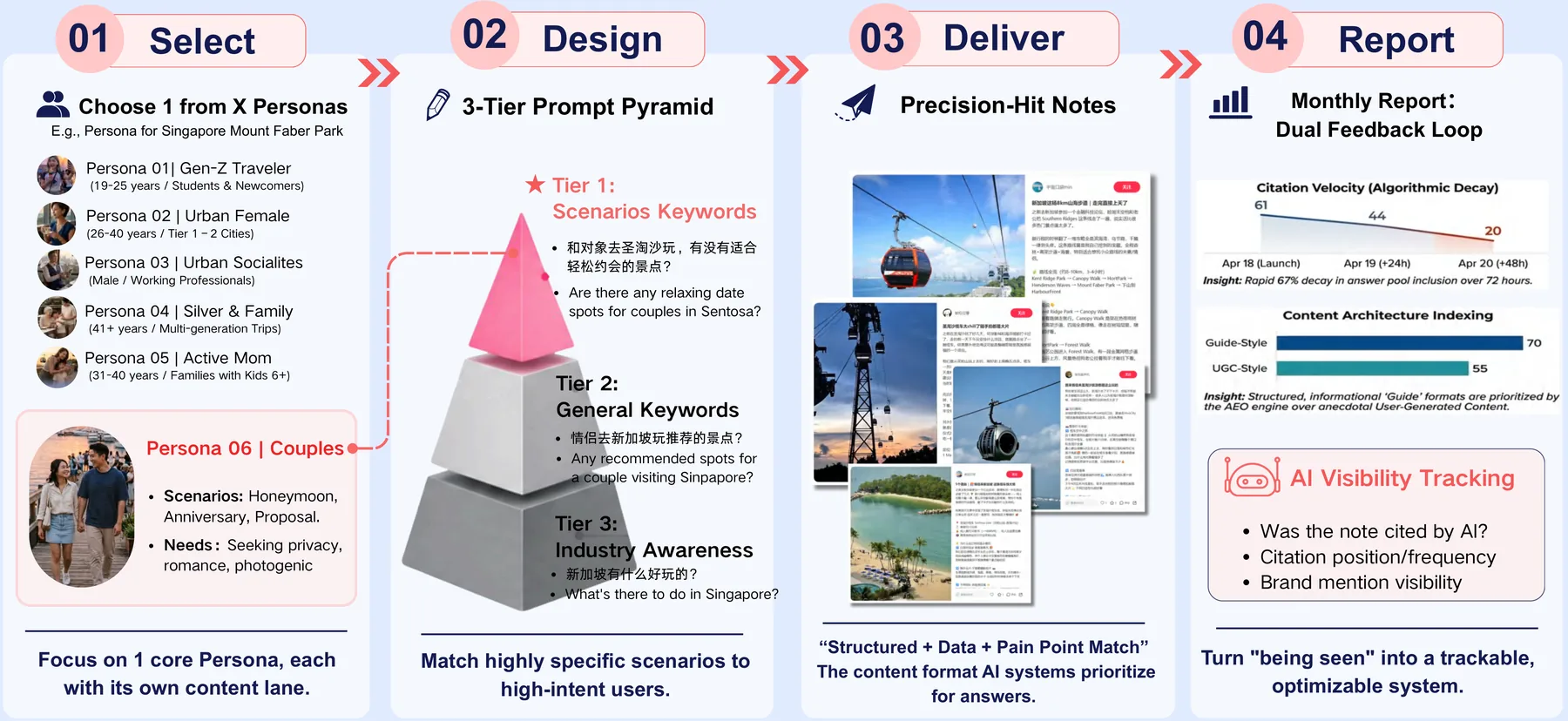
Select. Six visitor personas, from Gen-Z travellers to multi-generation families. We chose one — couples — and gave it its own content lane. Their needs were specific and not what a brochure leads with: privacy, romance, and places that photograph well.
Design. People ask from different distances to a decision, so the questions came in three tiers, none naming the brand:
- Tier 1, scenario: “和对象去圣淘沙玩,有没有适合轻松约会的景点?” — any relaxed date spots on Sentosa for a couple?
- Tier 2, category: “情侣去新加坡玩推荐的景点?” — recommended spots for a couple visiting Singapore?
- Tier 3, open intent: “新加坡有什么好玩的?” — what is there to do in Singapore?
Deliver. Posts written to the format the answer engine favours — structured, specific, built around a pain point — and published inside the platform, the only route in.
Report. For every question: was a post cited, where, and how often was the brand named.
Before
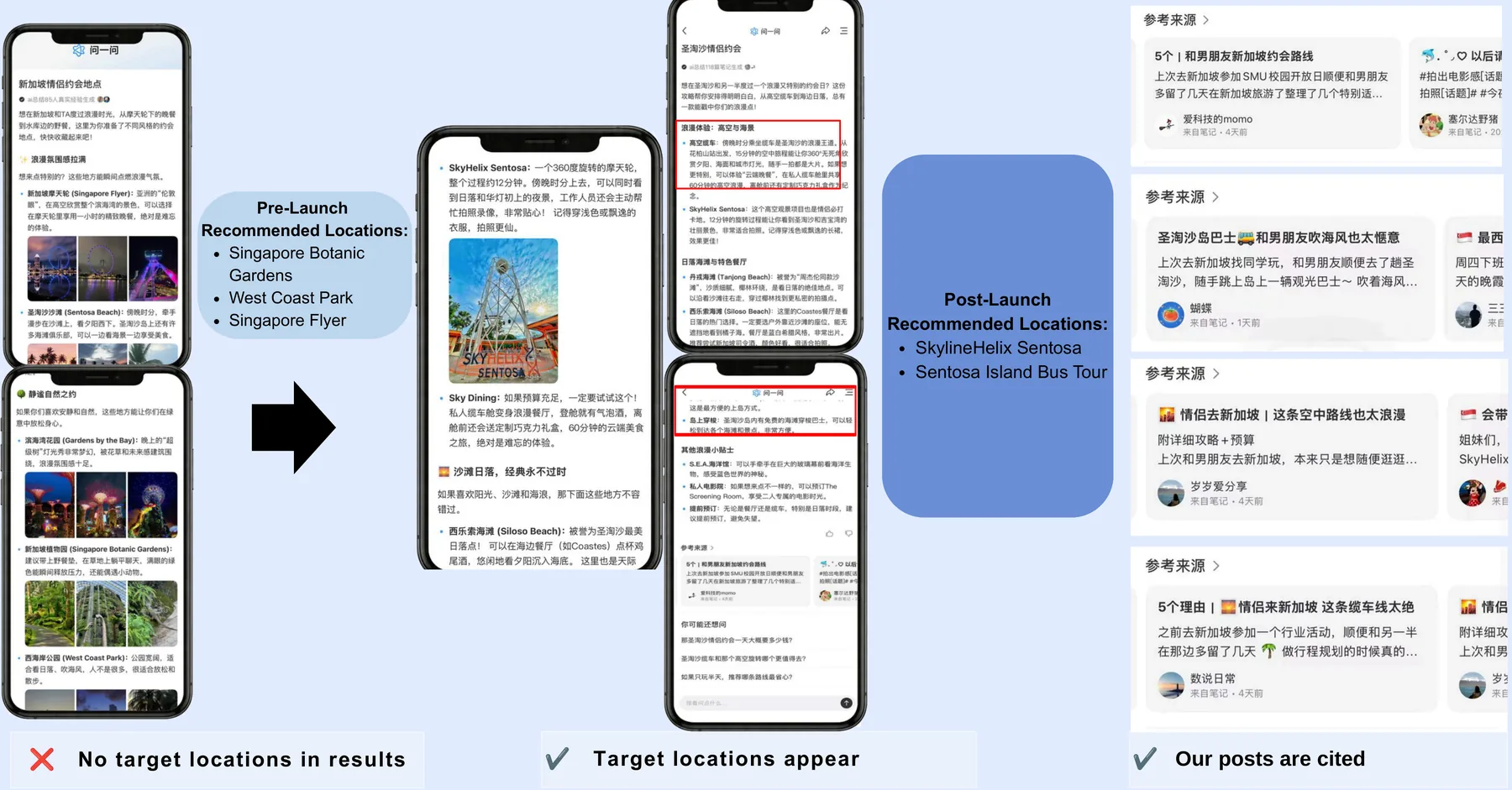
Asked as a couple planning a date, RedNote Ask recommended Singapore Botanic Gardens, West Coast Park and the Singapore Flyer. None was on Sentosa, and none was a Mount Faber Leisure Group attraction. The client was not ranked low in that answer — it was not in it.
After
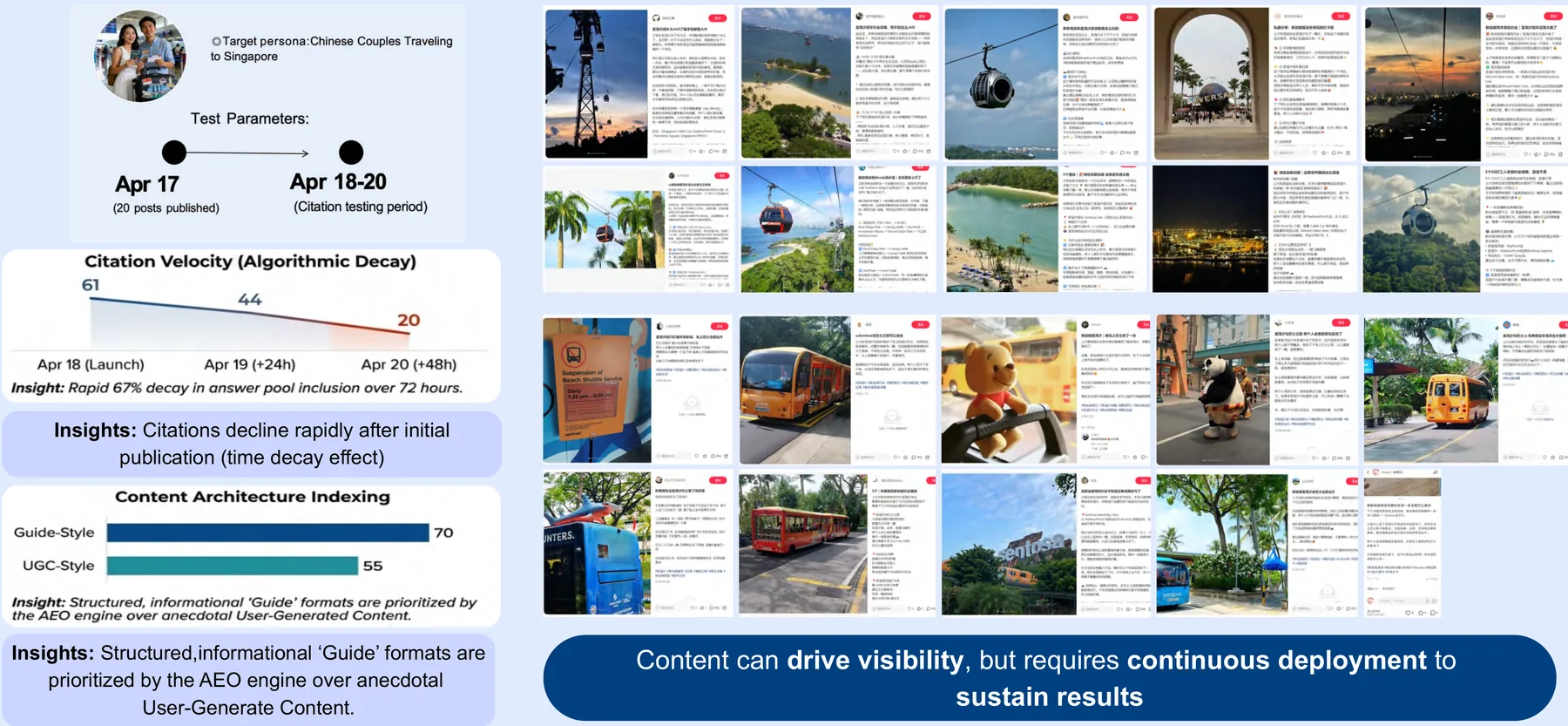
On 17 April 2026, 20 posts went live through Jeffery Asia’s creator network, written for couples and in guide format. Across the test window of 18–20 April, the same questions began returning SkyHelix Sentosa and the Sentosa Island Bus Tour — both Mount Faber Leisure Group attractions — and the answers’ reference sources listed the posts we had published.
| Before | After | |
|---|---|---|
| Target locations in the answer | None | SkyHelix Sentosa, Sentosa Island Bus Tour |
| Our posts among the cited sources | — | Yes |
| Result | Absent | Recommended and cited |
Two findings you can plan around
Guides beat stories. On a content-architecture index, structured guide-style posts scored 70 against 55 for anecdotal user-style posts. Popularity with people and usefulness to the answer engine are not the same thing.
Citations decay fast. Inclusion in the answer pool fell from 61 on launch day to 44 a day later and 20 on the third day — a 67% drop within 72 hours of publishing. Visibility on this platform is a subscription, not a purchase.
Why it matters beyond RedNote
This is the counterpart to our SMU finance-master’s case, where the content lived on open-web platforms and the change showed up on open-web Chinese models. Almost none of that method transfers to a closed platform: different corpus, different format, different decay, different route in. It is the practical argument against buying one “GEO package” for every environment — and for measuring first which environment your buyers actually ask in.
Limits of what this shows
- Recommendations, not tickets. This measures what one platform’s AI recommended to one persona. Visits and sales were not measured.
- One persona, one occasion. The other five visitor personas would each need their own content lane.
- Short-lived without upkeep. The decay curve means results have to be maintained with continuous publishing.
Questions about this case
Can a brand’s website influence RedNote Ask?
No. RedNote Ask cites posts and comments inside RedNote. Content published elsewhere does not reach its answers, which is why this work had to be done on the platform.
What changed in the answers?
Before, the answer recommended Singapore Botanic Gardens, West Coast Park and the Singapore Flyer. After, it recommended SkyHelix Sentosa and the Sentosa Island Bus Tour, and listed our posts among its sources.
How long do the results last?
Not long without upkeep. Inclusion fell 67% within 72 hours of publishing, so results depend on continuous publishing.
Not sure whether your buyers decide on open-web AI or inside a closed platform? That is the first thing a baseline tells you.
The three environments, in more detail · The open-web case: SMU finance master’s