In brief
- A screenshot proves a brand appeared once. It cannot show whether the brand appears consistently, where it ranks, or what changed after optimisation.
- Jeffery Asia measures four dimensions — Mention Rate, Occurrence Frequency, Average Rank and Brand Content Ratio — and combines them into an AI visibility score that can be tracked over time.
- There is no universal score: visibility is measured by persona and scenario, against competitors, on the same questions, models and testing period.
- The change before and after optimisation matters more than the absolute score, and cited sources show what to change next.
In the previous article, we looked at a shift already under way: as users increasingly ask AI directly, ‘Which option is right for me?’ or ‘How should I compare these choices?’, AI is beginning to shape the consideration set before users visit an official website or submit an enquiry.
That raises a more practical question. If we see our brand in an answer from ChatGPT, Doubao or another model, does that mean our AEO work has succeeded? For Jeffery Asia, the answer is not that simple. A screenshot can prove that the brand appeared once, but it cannot show whether the brand appears consistently in AI-generated recommendations or what changed after optimisation.
AEO measurement should answer more than whether AI mentions a brand. It should show whether the brand appears consistently, ranks prominently, receives sufficient coverage and shows measurable change after optimisation.
Why a Screenshot Is Not Enough to Demonstrate AI Visibility
AI-generated answers are not fixed search results. The same question can produce different recommendation orders, cited sources and wording:
- at different times;
- across different models;
- even across repeated responses from the same model.
If we ask once and capture one screenshot, we learn only that the brand appeared at that particular moment. We do not know:
- whether the appearance is consistent;
- where the brand sits within the answer;
- how much attention it receives;
- how it compares with competitors.
Meaningful AEO measurement must turn a one-off ‘yes or no’ into data that can be tested repeatedly and compared over time.
From a Single Mention to Four Measurable Dimensions
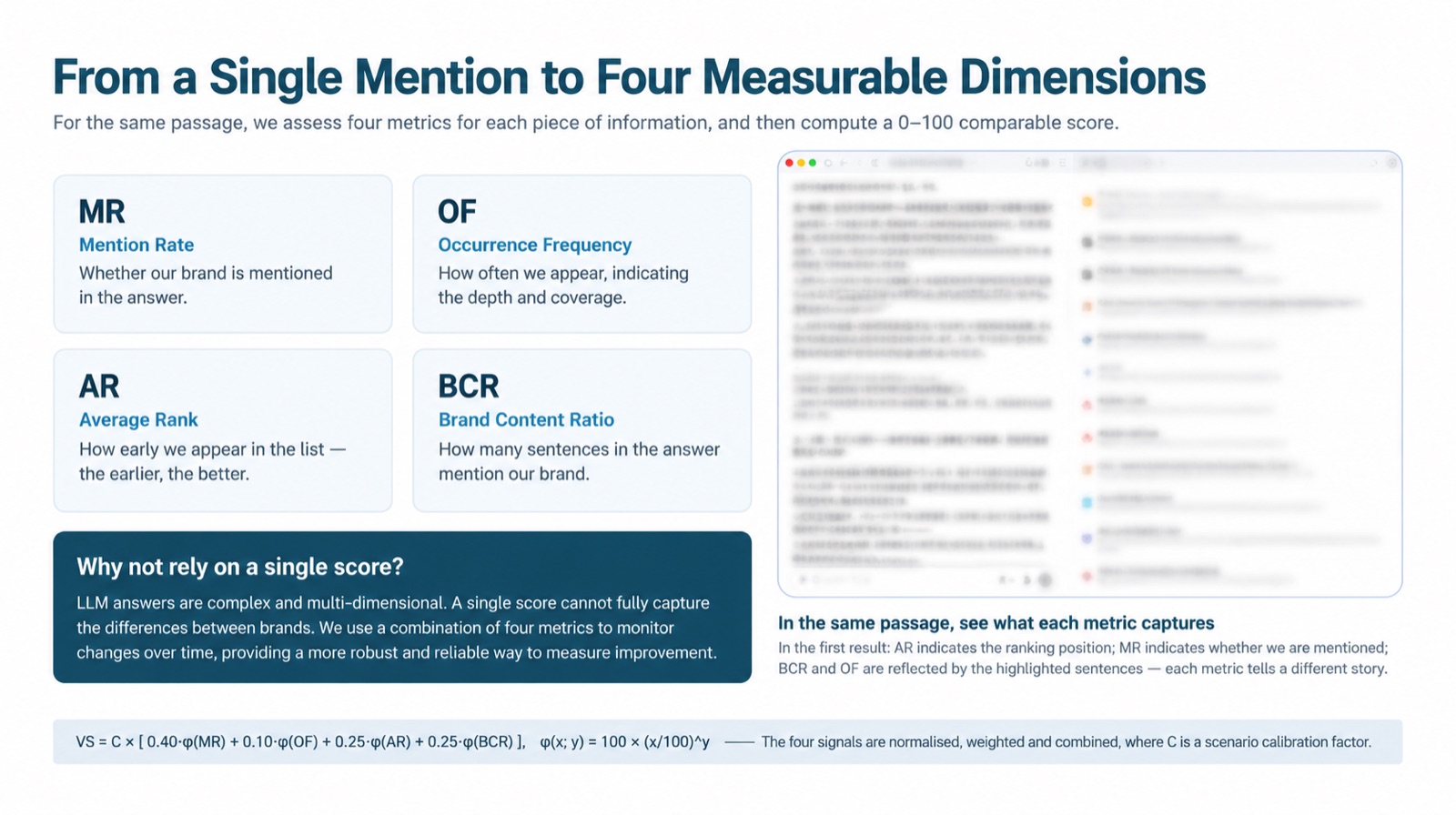
In our current work, we assess a brand’s performance in AI-generated answers across four dimensions.
| Dimension | What it measures | Why it matters |
|---|---|---|
| Mention Rate (MR) | The proportion of answers that actually mention the brand, when the same type of question is tested repeatedly | Shows whether the brand appears consistently across different responses |
| Occurrence Frequency (OF) | How often the brand appears within a single answer, considered in relation to response length | Longer answers naturally tend to contain more brand mentions, so an absolute count alone would mislead |
| Average Rank (AR) | The brand’s relative position when AI presents several universities, products or services | First and fifth place both count as a mention, but they do not have the same influence on a user’s consideration set |
| Brand Content Ratio (BCR) | How much of the answer is genuinely devoted to the brand, beyond how many times its name appears | Separates a brand simply included in a list from one AI spends meaningful space on: its strengths, relevant audiences, points of difference and reasons to choose it |
Once normalised and combined according to a consistent set of rules, these dimensions can produce an AI visibility score that can be tracked over time. The purpose is not to create an impressive-looking number. It is to make the same brand’s performance comparable across:
- different periods;
- different audiences;
- different models.
AI Visibility Must Be Assessed by Persona and Scenario
There is no universal AI visibility score for a brand. Consider two applicants:
- Applicant A is considering a career change.
- Applicant B is seeking a degree to support a promotion.
They may be similar in age, location and educational background, yet ask AI entirely different questions. The answers AI finds and organises will change accordingly.
Visibility measurement should therefore answer more than ‘What is this brand’s AI score?’. It should show:
- which audiences and decision scenarios make the brand more likely to be seen;
- where competitors are more likely to be recommended instead.
AI visibility becomes strategically useful when a brand and its competitors are compared using the same personas, questions, models and testing period. Rather than pursuing broad exposure across every possible question, this allows us to identify:
- Where to gain ground: the audiences where the brand needs to catch up;
- Where to defend: the scenarios where an existing advantage should be protected.
Change Before and After Optimisation Matters More Than the Absolute Score
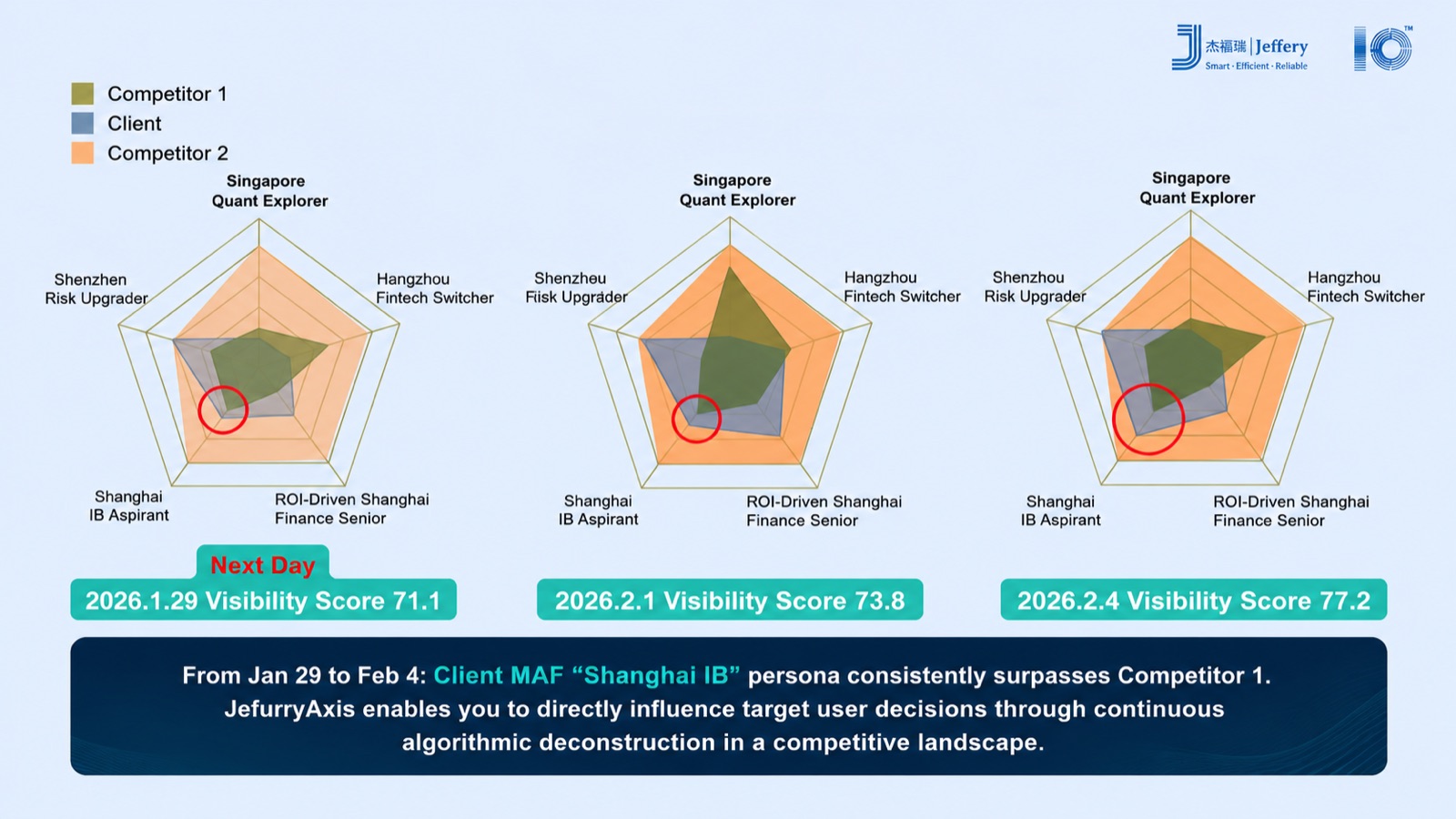
AEO must ultimately show what changed and whether performance improved. The comparison runs in four steps:
- Baseline. Test with a set of personas and questions.
- Optimise. Correct a website structure, reorganise an article or add new content to target sources.
- Re-test. Repeat the test using the same personas and questions from the previous round.
- Compare. Assess whether mention rate, ranking, content share and cited sources have changed.
This before-and-after comparison is particularly important because AI models still operate as black boxes.
| What we cannot do | What we can do |
|---|---|
| Promise that an article will be cited after publication | Keep a record of how models change |
| Assume that one effective optimisation will remain effective indefinitely | Record which content models are more likely to retrieve, and which actions are followed by observable improvement |
In other words, AEO is not a one-off exercise designed to prove success. It is a repeatable system for diagnosis and feedback.
The Score Is Only Part of the Picture
Once visibility has been quantified, the next set of questions becomes more important:
- Why did AI recommend this brand?
- Which sources did it cite?
- What content did it rely on when recommending a competitor?
- Does the same approach to writing work equally well across different models?
This is one of the clearest differences between AEO and conventional exposure monitoring:
- A visibility score tells us where the brand currently stands.
- Analysing cited sources and answer structure helps us decide what to change next.
For Jeffery Asia, AI visibility is therefore not a standalone KPI. It provides a diagnostic view of how four things interact: user intent, the competitive context, source ecosystems and content optimisation. Only when visibility can be observed, compared and reviewed over time does being ‘seen by AI’ become a growth capability that a brand can manage.
In the next article, we will explore why website optimisation is only the first step in AEO, and why different AI systems draw answers from very different source ecosystems.
If you would like to understand your brand’s visibility across leading models such as ChatGPT, Claude, Gemini, Doubao, DeepSeek and Qwen, and see how it performs across different audiences, scenarios and competitive contexts, get in touch with Jeffery Asia. Our persona-led AI visibility measurement can help you identify current gaps, set clear optimisation priorities and establish a repeatable growth process, so your brand is more consistently seen, cited and recommended by AI.