In brief
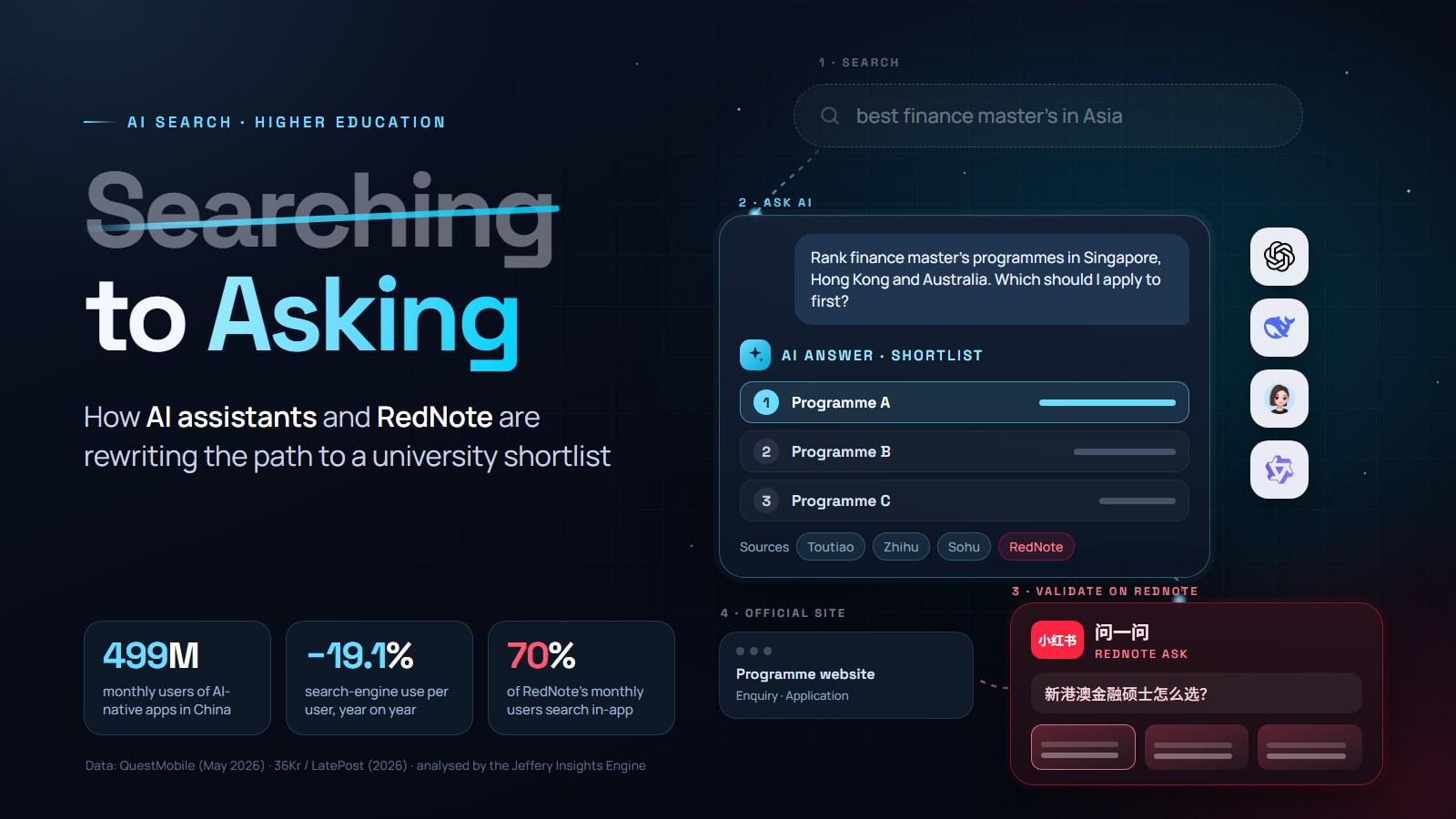
- AI-native apps in China reached 499 million monthly users in May 2026, up 85.4% year on year. In the same month, each user’s use of traditional search fell 19.1%.
- RedNote already works as a search engine: over 70% of its monthly users search in the app. Its AI feature, RedNote Ask, now answers searches in writing, using only posts from inside the platform.
- University recruitment is feeling it early. Chinese applicants now weigh employment, work rights and cost, which are exactly the comparisons people ask an AI assistant to rank.
- What works is measurable. In one diagnosis, a school’s own website was cited zero times by Chinese AI models. In another case, ten articles written for one applicant persona lifted SMU’s AI Visibility Score from 69.1 to 77.2 in seven days.
The analysis in this article comes from the Jeffery Insights Engine, our research engine for public sentiment and industry insight. Every third-party figure is linked where it appears and listed in full at the end.
Picture a final-year finance student in Shanghai, a month before application deadlines. A few years ago the routine was simple. Type a query into a search engine, open a ranking table and a dozen programme websites, and build a shortlist by hand.
Today that student is more likely to ask Doubao or DeepSeek a single question: rank the finance master’s programmes in Singapore, Hong Kong and Australia by placement, alumni strength and work visas, and tell me which to apply to first. Then they open RedNote to see what students like them say about the top two. The programme website comes later, if the programme is still on the list.
This article looks at that shift through three questions. Is the move from searching to asking real, or just anecdote? Where does RedNote fit? And for universities that recruit in China, what has actually worked?
The path used to look like this:
- Search engine
- Ranking tables
- Programme websites
- Enquiry
Now it increasingly looks like this:
- Ask an AI assistant
- Validate on RedNote
- Programme website
- Enquiry
1. The Data: People Are Asking Instead of Searching
The move to AI answers is already visible in usage data, not only in surveys about intentions.
According to QuestMobile’s first-quarter 2026 AI report, AI-native apps in China had 440 million monthly active users by March 2026. The top three were Doubao (345 million), Qwen (166 million) and DeepSeek (127 million), and the category added more than 130 million users in a single quarter.
Two months later, QuestMobile’s 2026 half-year report put the figure at 499 million, up 85.4% year on year, with each user opening an AI-native app 92.7 times a month. The same report recorded the other side of the shift. In May 2026, per-user use of traditional search fell 19.1% year on year, and time spent on it fell 13.5%.
| Indicator | Figure | Period |
|---|---|---|
| AI-native app monthly users, China | 440 million | March 2026 |
| Doubao · Qwen · DeepSeek monthly users | 345M · 166M · 127M | March 2026 |
| AI-native app monthly users, China | 499 million (+85.4% YoY) | May 2026 |
| Monthly uses per AI-native app user | 92.7 | May 2026 |
| Traditional search: uses per user | −19.1% YoY | May 2026 |
| Traditional search: time per user | −13.5% YoY | May 2026 |
Search is not disappearing. What is moving is the first step of a decision. A search engine returns a list and leaves the comparing to the user. An assistant does the comparing and returns a verdict. For a brand, the practical difference is that there is no second page to rank on. You are either in the answer or you are not.
2. RedNote: A Search Engine That Looks Like a Social App
For many young Chinese users, the habit of asking for answers started on RedNote, well before AI assistants.
RedNote (Xiaohongshu) is usually filed under social media. Its usage says otherwise. Fashion China Agency’s 2026 statistics roundup, drawing on 2025 data, reports more than 1 billion searches a day, around half of all traffic coming from search, and search used by 70% of monthly users. In May 2026, LatePost reported that RedNote had passed 400 million monthly and 170 million daily active users in China, as cited by 36Kr. The same piece notes that over 70% of monthly users use in-app search.
The audience also overlaps closely with postgraduate recruitment. According to the same Fashion China Agency roundup, more than 43% of users are aged 18–24, more than 36% are 25–34, and 66% live in tier-one and new tier-one cities. AppleWorld describes the platform the same way: people use it to search for real-life recommendations, and brands build for that.
Two developments now pull RedNote and AI answers together:
- Inside RedNote, answers are becoming AI answers. RedNote Ask (问一问) replies to a search with a written answer, built only from posts and comments on the platform. A school’s website, press coverage and rankings are not in that corpus at all.
- Outside RedNote, assistants are taking over the scrolling. 36Kr’s analysis describes users asking Doubao for a recommendation instead of reading notes, compressing a browsing session into a few seconds. It also notes that RedNote’s standalone AI app, Diandian, ranked only 186th on the App Store download chart in April 2026.
Either way, the note is becoming raw material and the AI answer is becoming the interface. Competition on RedNote is shifting from the feed to the answer layer.
3. Why University Recruitment Feels It First
The QS International Student Survey 2026 report on China shows two things about how Chinese applicants decide.
The sources they trust are the sources AI reads. Their most influential information sources are:
- Official university websites: 73%
- Rankings: 65%
- Social media: 61%
- Education agents: 41%
- Family and friends: 39%
The questions they ask have become comparisons. Since 2022, the importance of post-study work rights has risen 14 percentage points and graduate employment 11 points. Cost matters to 38% of students, up from 30%. A country’s general reputation as a study destination has fallen 15 points.
Put those together and you have the kind of question applicants now hand to an assistant: rank these programmes by employment outcome, work visa and total cost. It has many factors, it needs sources, and it returns one synthesised answer. Which sources that answer is built from depends on where it is asked:
| Environment | What the answer is built from | Where content has to be |
|---|---|---|
| Chinese open web Doubao · DeepSeek · Qwen | Open-web retrieval layered on each parent ecosystem’s own content | Third-party content platforms, long-form Q&A, structured site content |
| International open web ChatGPT · Claude · Gemini | Official sites, authoritative media and rankings, weighted by perceived authority | English FAQ and structured data, rankings and directories, trade media, communities |
| Closed platforms RedNote Ask · Tencent Yuanbao | Content from inside the platform’s own ecosystem only | Inside the platform itself: creator and user content. Nothing published elsewhere gets in. |
4. What We Have Seen in Education
Case A: a top-ranked programme that AI reads through other people’s pages
In 2026 we ran a diagnosis for the finance master’s programme of an Asian business school. We used 30 questions that never name a brand (five applicant personas, two situations each, three questions per situation). Each was repeated across three international and three Chinese AI models and benchmarked against four rival programmes the school named.
The composite AI Visibility Score was 74.98, first of five. The average hid two problems:
- One persona collapsed on one track. On international models, the early-career accountant scored 32.6, behind two rivals at 50.2 and 47.3.
- On Chinese models, the school’s own website was cited zero times. The most-cited sources were third-party education and content platforms: liuxue.xdf.cn (208 citations), m.sohu.com (116), news.koolearn.com (89), baijiahao.baidu.com (68) and m.toutiao.com (63). On international models a directory led (best-masters.com, 166), and three rivals’ official sites were each cited more often than the school’s own.
The content was not weak. It was in the wrong place. On the Chinese track, what a school publishes on its own site and official account is simply not where AI goes looking.
Case B: SMU, ten articles for one applicant in seven days
For Singapore Management University’s Master of Applied Finance, we picked one persona: a Shanghai finance undergraduate aiming at front-office investment banking, with deadlines approaching. The baseline on four Chinese models was 69.1, and NTU was ahead of SMU for this applicant.
We published ten articles on Toutiao, Douyin, Sohu, Bilibili and Zhihu, the platforms the baseline showed these models cite, and did not touch SMU’s website. Over seven days the score rose 69.1 → 71.1 → 73.8 → 77.2, and SMU moved ahead of NTU for the target persona. Five of the ten articles were cited as sources, four by Doubao and one by DeepSeek. They were cited only under that persona’s questions and under none of the other four. Read the full SMU case.
Case C: inside RedNote, guides beat stories and citations fade
Our clearest closed-platform evidence comes from tourism rather than education, but the mechanics carry over. On RedNote Ask, 20 guide-style posts for one visitor persona took a client from absent to recommended and cited. Structured guides scored 70 against 55 for anecdotal posts on a content-architecture index, and inclusion in the answer pool fell 67% within 72 hours of publishing. Read the RedNote case.
In education, the gap usually starts earlier. When we reviewed a Singapore graduate school’s RedNote presence in 2026, a search for its name returned a steady flow of notes from current students, graduates and agents, and no official content at all. The sentiment was positive. What was missing was an answer to the question applicants were actually stuck on: it is good, but which programme should I choose? Interest was already there. Nobody caught it at the final step.
5. What This Means for Admissions and Marketing Teams
- Measure the answer, not the web page. Start with a baseline: your applicant personas, the questions they ask without naming you, and where AI places you against the programmes you actually compete with.
- Find where each model reads before you publish. Chinese models, international models and RedNote Ask draw on different sources. One content package for all three means spending in the wrong place for two of them.
- Write for the comparison question. Give verifiable numbers on employment, work rights and total cost, and say plainly who a programme is not for. That is the evidence models quote.
- Treat RedNote as both a search engine and an answer engine. You need enough guide-format content, in enough volume, to cover what applicants search, and you need to keep publishing, because citations fade.
- Re-test on the same basis every month. Use the same questions and the same models, and compare the results. Model updates alone can move a score, so a single screenshot proves very little.
How JefurryAxis Helps
JefurryAxis is Jeffery Asia’s AI visibility platform. It is built on Kurt Lewin’s behaviour equation, B = f(P, E): what someone asks depends on who they are and the situation they are in. So we do not start from keywords. We start from your applicants and the weeks they are having.
- Detection Engine: builds personas from your own material and generates the questions they would ask without naming you. It samples answers repeatedly on international and Chinese models, and covers RedNote Ask and Tencent Yuanbao through team-assisted runs. The result is an AI Visibility Score, benchmarked against your rivals, with the sources each model actually cited.
- Optimization Engine: turns the findings into content written for a specific persona, graded before publication, and placed where the models read.
- Growth Engine: Jeffery Asia’s team distributes that content across owned, earned and social channels, including RedNote creators, and re-tests every month on an unchanged basis.
Why teams use it:
- Persona-level, not brand-level. We show which applicants you win and which you lose, not a single average that hides both.
- Two tracks, never averaged. Chinese and international models are scored separately, because they read different sources.
- Closed platforms included. RedNote Ask is measured and optimised on its own terms.
- A tested method. The persona-driven approach is set out in “Persona-Driven AI Engine Optimization in Zero-Click Search”, accepted for an oral presentation at ANZMAC 2026 after peer review.
- Honest limits. We do not promise guaranteed citations or rankings. We commit to measured change on named personas, with evidence you can re-test.
Want to see where your programme stands in AI answers today? Contact our sales team. We will run a baseline on your applicant personas across the models your applicants use, and show you where to start.
About the Data: the Jeffery Insights Engine
This article draws on the Jeffery Insights Engine, Jeffery Asia’s research engine for public sentiment and industry insight. It tracks market, policy, competitor and social-media signals every day, including conversations on RedNote, and turns them into the situation (E) half of every JefurryAxis run. The questions we test move with your applicants’ week, not with last year’s brief.
Figures from third parties are linked where they appear and listed below. The case figures come from Jeffery Asia’s own client work. Case A is anonymised.
Sources
- QuestMobile, QuestMobile 2026年一季度AI应用洞察 (2026 Q1 AI application insight), 21 April 2026.
- QuestMobile, QuestMobile 2026年AI应用市场发展半年报 (2026 AI application market half-year report), 14 July 2026.
- Fashion China Agency, Latest Xiaohongshu (RedNote) Statistics (2026), 10 April 2026.
- 36Kr (from TopKlout), Xiaohongshu urgently needs a “second growth curve”, 16 July 2026. Cites LatePost for the monthly and daily active user figures.
- AppleWorld.Today, What Is RedNote, and How Do Brands Use It?, 10 July 2026.
- QS, Student mobility and motivation: China, QS International Student Survey 2026.